The 2013 Game Developers Conference is over. The chatter of the show floor has faded, the bathroom lines have evaporated, and the various stacked hangovers have worn off. The week still feels like something of a blur, but squint your eyes just so, filter out the noise and the music and the glowing laptop monitors, and a theme starts to take shape: Change is in the air. Change for the better.
If I had to boil the week down to one pithy phrase, I suppose I’d choose “We can do this better.” If I was given the opportunity to add a second phrase, it’d be “We can have our cake and eat it, too.”
https://lastchance.cc/spec-ops-writer-on-violent-games-were-better-than-th-460992384%3C/a%3E%3C/p%3E
With each passing GDC, the indie presence has become more and more pronounced, but this year felt like something of a tipping point. Moreover, it’s beginning to feel as though the mainstream “AAA” developers and publishers have woken up to the many brilliant things that indie games have to offer. “We’re not so different, you and I.”
I attended my first conference in 2010 and, upon leaving, I remember remarking as to how it felt as though there were two GDCs: The optimistic, artistic indie GDC and the conservative, money-minded corporate GDC. Game designer Jesse Schell may have summed up the divide most pithily upon his departure at the end of last week:
Goodbye, #GDC13 … Every time I smell corporate fear and unrealistic indie optimism, I'll think of you.
— JesseSchell (@jesseschell) March 29, 2013
That distinction remains in effect four years later, even while it’s feeling like the indies have taken over a bigger-than-ever chunk of the mainstream. Independent and progressive developers are indeed always optimistic at GDC, and as an optimistic, indie-minded sort, I tend to favor their viewpoint. But this year, I was surprised to find a solid core of pragmatism at the heart of a lot of the wide-eyed optimism. “We can do better, we can be more inclusive, we can be less violent and more interesting, and we can make more money as a result.”
On Monday night, I attended a grand indie gathering at the video-game website IGN‘s offices near to the Moscone center, where GDC itself is held. Dozens of independent developers had brought their PCs, dev consoles and iPads to show off the latest builds of their games. The energy in the room was remarkable: Boisterous, enthusiastic, and a little bit drunk.
That same night, there was another indie showcase going on, this one hosted by Sony. I couldn’t attend both events, but during an earlier demo session in Sony’s space I saw an event space kitted out with demo stations for an array of PS3 and Vita indie games. It seems evident that Sony, a billion-dollar technology company, would very much like you to know that Hotline Miami plays great on the Vita. This feels noteworthy.
The sense among the indie developers that I spoke with was that Sony has invested in them in a tangible, financial way. (See also: Sony’s well-timed announcement of a partnership with Unity that will allow the indie-friendly development tools to work seamlessly with all of their platforms.) Both Nintendo and Microsoft had a more low-key presence at the conference, with Nintendo revealing a web framework to help developers make apps for the Wii U and Microsoft staying almost entirely out of view, likely because they have yet to publicly announce their own next-generation console. Sony certainly won the largest amount of mindshare among independent developers, and appear to be gambling that they can have their interesting, creative indie games and make money with them, too. Have their indie cake and eat it too, if you like.
Inclusivity, gender inclusivity in particular, was also a running theme at this year’s GDC, far more so than in previous years. That’s fitting, given that the industry has seen so much discussion of the topic over the past year or so. Early in the week at the narrative summit, Halo: Reach writer Tom Abernathy gave a talk arguing that more and more players are tired of not seeing themselves reflected in their games, and that increasing diversity wasn’t just worthwhile from a moral perspective, it was good business sense. It was a familiar refrain, but still a valuable one: Sure, it may be widely held that games with female protagonists make less money, but does that line of thinking even make sense?
Another video game writer, BioWare’s David Gaider, addressed that line of thinking directly. In the middle of his talk titled “Sex in Video Games,” the Dragon Age and Baldur’s Gate writer put up a slide showing six video games with female protagonists featured on the cover, games like Beyond Good & Evil, No One Lives Forever and the new Tomb Raider.
“Is conventional industry wisdom correct?” Gaider asked, referring to the idea that games with women on the cover don’t sell. “There’s been a lot of discussion about female protagonists, especially putting them on the box.
“This is not a large number of titles,” he said, gesturing to the six games on the slide. “This is over how many years? Are we supposed to accept the opposite, that a game that has a male protagonist and sells well sells well because it had a male protagonist? What about the ones with male protagonists that don’t sell well? Are those for other reasons?
“What would be the bar at which the industry would change its mind about a female protagonist? Do we need a title to sell ten million copies? Is that the bar, at which suddenly they’re marketable? Are we requiring the female protagonist to work harder and sell more in order to prove herself? What kind of bullshit is that?”
That kind of aggressive, blunt language popped up elsewhere during the week as well. One of the most passionate and well-received sessions of the entire conference was the #1ReasonToBe panel, which brought together six women from the games industry to follow up on the devastating #1ReasonWhy twitter campaign.
The next day, Romero was awarded a lifetime achievement award from the Women in Gaming organization hours after forcefully speaking out against an IGDA party that featured scantily clad dancers. Romero publicly resigned her position in the IGDA, prompting a panicked non-apology from the organization. While the three events were technically unrelated, it was difficult not to take them together as a sign of the times.
Even more riled-up language dotted the popular annual “rants” panel, which features several game developers giving fiery five-minute talks about whatever’s pissing them off at the moment. Midway through the panel, indie game developer and author of “Rise of the Videogame Zinesters” Anna Anthropy gave an impassioned reading of Cara Ellison’s poem “Romero’s Wives,” a listing of the many injustices women face in the video game industry.
Had to be Margaret Robertson not wearing skirts and not wearing heels
Had to be Jenn Frank explaining equality is compassionate to all
Had to be a handful of female main characters in a triple A sea
Had to be trying to write like a man when ‘man’ isn’t a standard
The games industry is a young man in love with his libido
I have a libido
The title is a reference to how Brenda Romero is often viewed solely as the wife of Doom co-creator John Romero. Anthropy’s reading was upsetting, controversial and intense—exactly the sort of thing that the GDC rants are supposed to be—and like Romero’s own talk the day before, it drew many members of the audience to their feet.
At the same panel, researcher and Redshirt developer Mitu Khandaker made some pointed observations about racial inclusivity in games, and reminded the crowd that all of the talk about gender inclusivity applies to race, too. “For [some] people,” Khandaker said, “the notion of wanting to see more nonwhite characters in games is somehow politicizing things. Or worse, my most hated of phrases, that you’re just being ‘politically correct.’ Politically correct! As if just treating people who are different from you as fucking human beings is exerting some sort of special effort because you’re not being genuine, or because you’re some holier-than-thou type. Fuck. That.” Immediate, resounding applause. Khandaker continued: “If you think that minority representation in games is pushing some kind of agenda or [is] being politically correct, you’re already living an agenda every day. It’s already fucking political. It’s always been political, and the only reason we don’t realize it is that it’s been so political for so fucking long.”
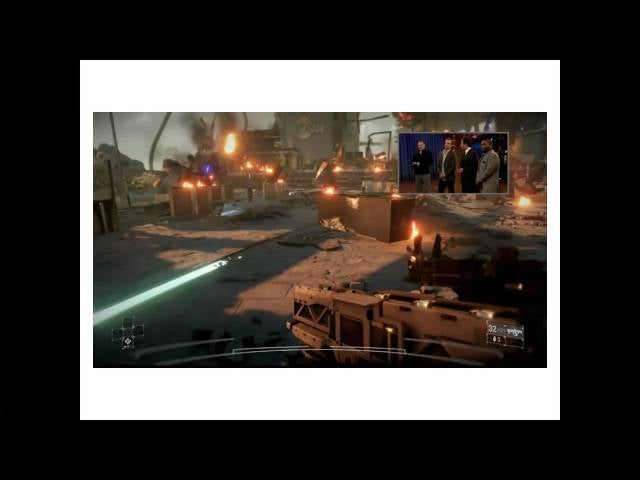
In an unlikely rant-panel highlight, Spy Party developer Chris Hecker gave a brilliant, pointed “rant” in which he didn’t say a single word, but rather let the often hilarious disconnect between many AAA developers’ high-minded talk and their lowbrow, ultra-violent products speak for itself:
Anna Marsh, game designer and owner of Lady Shotgun, gave an engaging talk about game development’s infamous “crunch time,” and how important it will be to change course for the better. In her words, “You don’t have to work 18-hour days, sleep under the desk and shit in the corner to make games.” Marsh argued that with proper pre-production, game developers could live more balanced lives, and, crucially, the result of this would be better games. It’s not healthy, she argued, for creators to live, eat, breathe and sleep games, not only for basic lifestyle reasons, but because it leads to creative stagnation. A more diverse lifestyle and reduced crunch won’t just make game developers’ lives better, it’ll lead to more interesting, varied games.
Several noted game-makers took the stage at various points in the week to encourage their peers to step away from the mindless violence and thin storytelling that still define many big-budget games. BioWare designer Manveer Heir gave an introspective microtalk in which he suggested that developers put more of themselves into their games and embrace their own vulnerability. He cited Papo & Yo as a challenging but beautiful game that forced him to come to terms with his troubled relationship with his brother. “What’s important isn’t that the experiences are autobiographical,” Heir said, “but rather they represent something personal, because those experiences are likely to capture a universal truth.”
Earlier in the week, Spec Ops writer Walt Williams gave a terrific talk about reconciling video games’ extreme violence with game writers’ desires to tell better stories. (Read my more thorough writeup of his talk here.) “To be honest,” Williams said, “…we’re an industry full of very intelligent, often aggressive people, and we know that the blanket use of violence is wrong. It’s getting harder and harder for us to play these games and to look at them critically and say, ‘This is okay. This makes sense.’ Especially as we get older, especially as we play more of them. I will admit personally, I would like to see less violent games out there, not because I think that they’re bad or wrong, but because I think that creatively, they’re too easy. I think we’re better than that.”
Each year at GDC, there are two awards ceremonies back-to-back on Wednesday night. First, the Independent Games Festival honors indie games, while the Game Developers’ Choice awards are typically reserved for the big-budget games. The divide between the two ceremonies has long been emblematic of the differences between indie and big-budget games, but the winners this year blurred the lines between the two ceremonies until they were almost indistinguishable.
Small independent studio Thatgamecompany’s Journey took the lion’s share of “big budget” GDC awards, while the even smaller, kickstarted game FTL dominated the IGF awards. Other awards went to The Walking Dead, The Room, Little Inferno and Kentucky Route Zero. Some of those were GDC awards, others IGF awards. Most surprising of all, Richard Hofmeier’s startling, depressing and ultimately illuminating life-simulator Cart Life won both the IGF’s “Nuovo Award” for innovation and the Seamus McNally grand prize.
When I spoke with Hofmeier backstage after his win, he expressed genuine shock at his victory. “I feel stupid saying it now,” he said, “I’m kind of ashamed to admit it, but I want to be honest: I didn’t know any of this existed. I thought I was like, the first person to think of a self-portrait in the form of a game. And so now that I’ve become acquainted with these other games, they’re so good! So I’m really feeling the fraud stuff, the impostor stuff. I thought it was really audacious, I thought I was the first person to think of it. In the time since, I can see all of these beautiful, incredibly well-crafted games.”
I asked which games in particular had impressed him. “Well, Dys4ia is a good example, Cactus has tons of games that could be so-described. A lot of more interesting ones that are happening now are kind of in the realm of interactive fiction, really, women making games.”
The next day, in an effort to pay it forward, Hofmeier spraypainted over his IGF booth on the show floor and set up a demo for Porpentine’s interactive fiction game Howling Dogs. It was a surprising and generous move that effectively encapsulated the energy surrounding the entire conference.
The week ended, as it usually does, with the annual two-hour Experimental Gameplay Workshop, where game designers got up in front of a jam-packed hall to give mini-presentations about their most out-there, experimental ideas. We saw demos and explanations of recent buzzy games like Starseed Pilgrim and Jason Rohrer’s The Castle Doctrine, while Emily Short gave a demonstration of her AI-driven interactive fiction system Versu and Marc Ten Bosch demonstrated his difficult-to-conceptualize four-dimensional puzzle game Miegakure
The EGW is always a lovely, optimistic way to end the week (though its length and post-lunch timeslot can lead to some serious napping). This year it felt more exciting and galvanizing than ever. Almost every demonstration had an “applause moment”—the developer would successfully execute an advanced move in the game, prompting enthusiastic cheers from the crowd. “It works! It really works!” It was, at times, like watching the best version of a game-design circus act. For all the game industry’s talk of change, it’s nice to see that developers have the crazy ideas to bring that change about, particularly after so many panelists and speakers indicated an overarching eagerness to experiment and take more risks.
For all the good feels and positive vibes, any individual’s GDC experience is going to be self-selecting. It’s a massive conference, and I was only able to attend a handful of talks and see a sliver of what was on display. Naturally, I chose the things I was most interested in, though even then I wasn’t able to catch all of the progressive, thoughtful talks and panels. But for every talk about gender inclusivity and innovative design, there was another called “Build to Grow: Develop Your App with Monetization in Mind” or “Mobile Game Metrics and Your Market Strategy.”
So, yeah, it’s not all about making games a socially progressive artform. The week when game developers dream the biggest still has to compete with the other 51. But this year, it didn’t feel entirely like a dream. It felt like some people—many people, even—have woken up.
(Photos via GDC’s official flickr photostream, Cart Life booth photo by Jim Crawford, David Gaider’s Dragon Age photo by me.)