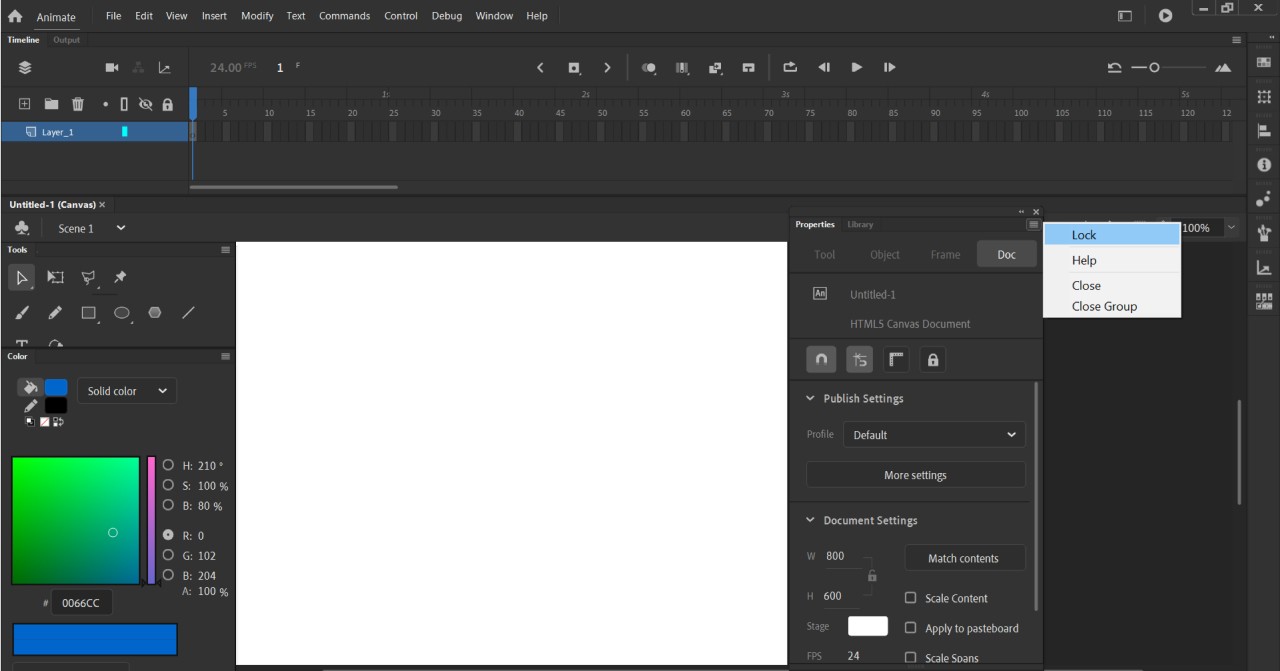
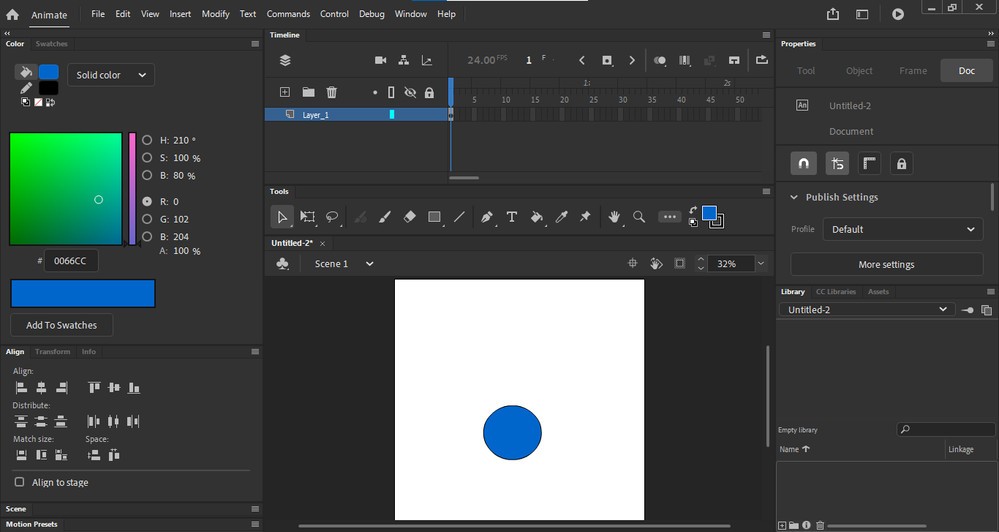
Adobe Animate is a 2D animation software developed out of Adobe Flash, though it functions differently nowadays. People resort to it to cause characters to move, generate small game art, or even generate web animations that react to a clicking or touch event.
It is between a drawing program and a scripting environment and provides flexibility in the tasks of simple hand-drawn loops to banners and educational material. Animate enables you to draw, rig, and animate on a timeline, and it does not impose a single animation system—by-frame, bone-based, or a combination of the two.
It is valued due to the ability to export to such formats as HTML5 Canvas, WebGL, GIFs, and video, and enables creators to present work nearly anywhere. Adobe keeps on updating the tool, with the new versions being much more efficient in performance and layout clarity, which is of more essence in the long term projects rather than flashy new buttons.
Should one desire an animation environment that will remain the same without requiring swapping of tools after every few minutes, Animate will meet that requirement in quiet and consistent silence.
What Are the Key Features of Adobe Animate?
The number of available tools in Animate is very extensive, and the users, depending on the object they are creating, mix them up. Its drawing capabilities accept both the vector-based artwork and the bitmap images; hence, you may sketch sketchy characters or bring in the fine designs. Envelope deformers enable you to press and bend the shapes without redrawing, and bones and rigging accelerate posing.
The workflow revolves around the familiar timeline, layers, timing, and transition keyframes and controls. Scripting is also supported with Animate, and therefore banners, mini-games, or interface effects can respond to clicks, hovers, or touches. One can add audio files to the project and match them to the animation, which is useful when it comes to a dialogue- or scene-heavy project.
Export flexibility is one of the characteristics that make Animate versatile. One project can be delivered as HTML5 Canvas on the internet, as a GIF on social media, as a video file, an Adobe AIR program, or even as a piece of material that works with AR. The workflow isn’t locked in. Traditional users of the frame-by-frame methods can continue to utilize them, whereas the rest operate rigs or a combination of both.
The software is also compatible with the Creative Cloud ecosystem, and assets of Fresco or Photoshop can easily migrate in. The latest changes have polished the UI, providing a larger workspace and more fluid performance when using a newer device.
Is Adobe Animate Free to Use?
Adobe Animate is not free. It is distributed by Adobe on a subscription basis, where users can pay either on a monthly or annual basis or with the entire Creative Cloud package. There is a free trial period before you start the subscription. Discounts for students and schools are available, but the software works in all plans.
Which Platforms Support Adobe Animate?
Adobe Animate is available on Windows and macOS. The newer versions are Apple Silicon optimized and have shorter launch times, smoother previews, and less overhead on modern Mac computers. The same happens with the Windows version, assuming that the machine can satisfy the system requirements of Adobe.
You can export HTML5 Canvas to browsers, WebGL, GIFs, video formats such as MP4, SVG, and Adobe AIR. Some developers make mobile applications or other lightweight games from these exports. Animate is made in such a way that the animation may be transported to browsers, game engines, social media, classrooms, and even TV content based on the workflow. The fact that it is compatible with many operating systems is central to the tool, though the software itself is only compatible with two operating systems.
What Are the Best Alternatives to Adobe Animate?
Professional studios prefer to use Harmony since it deals with frame-by-frame animation, rigging, and compositing. It provides a production-level system, node systems, and finer control of character rigs. In comparison to Animate, Harmony explores more into the areas of long-form animation, television pipelines, and heavy overlaying. When users feel they require the studio look and feel, they tend to switch to Harmony, particularly when they require additional control in deformation, shading, and rig arrangement. Nevertheless, Harmony is more difficult to learn, and it is priced like a pro. Some users download Harmony’s trial first just to see if the workflow suits their animation style.
Pencil2D Animation is an open-source, lightweight software that is used to make simple 2D animations. It is concerned with both bitmap and vector drawing without additional coding or interaction. Individuals who prefer to draw and animate manually or have a clean environment frequently use Pencil2D, as it eliminates distractions and can run even on lower-powered computers. It does not have the export capabilities and scripting of Animate, but when wanting to sketch, do some old-fashioned animation practice, or get accustomed to the principles, it is lightweight and friendly. Its non-existence of subscriptions is also appealing to newcomers. People often download Pencil2D quickly because it’s small, free, and easy to set up.
Moho Pro can be a viable competitor to those who enjoy rig-based animation. It has a richer bone system than Animate and has intelligent meshes, automatic weighting, and physics tools that assist in making more predictable character motion. It is suitable for simple cartoon work and ambitious projects and has timeline control, styles, and vector drawing. Moho Pro is more of a structured character animation tool than an interactive or banner-like tool, but it is perfect when the user requires clean rigs and smooth movement without the need to redraw each frame. Animators download Moho when they want strong rigging tools without relying on multiple programs.
Blender is mainly a 3D development package and gives the possibility of doing all 2D animation within a 3D framework through its Grease Pencil toolset. This provides artists with the room to draw, animate, and blend dimensions in a form that is not normally provided by traditional 2D tools. Blender is open-source and free, and it has modeling, rendering, scripting, and compositing tools; it has way more capabilities than Animate. Other artists render it with hybrid 2D-3D animation or stylized scenes, which would be more difficult to construct with a purely 2D program. It requires additional learning, but it gives open creative freedom. Because it’s free, many creators download Blender early just to experiment with 2D and 3D together.